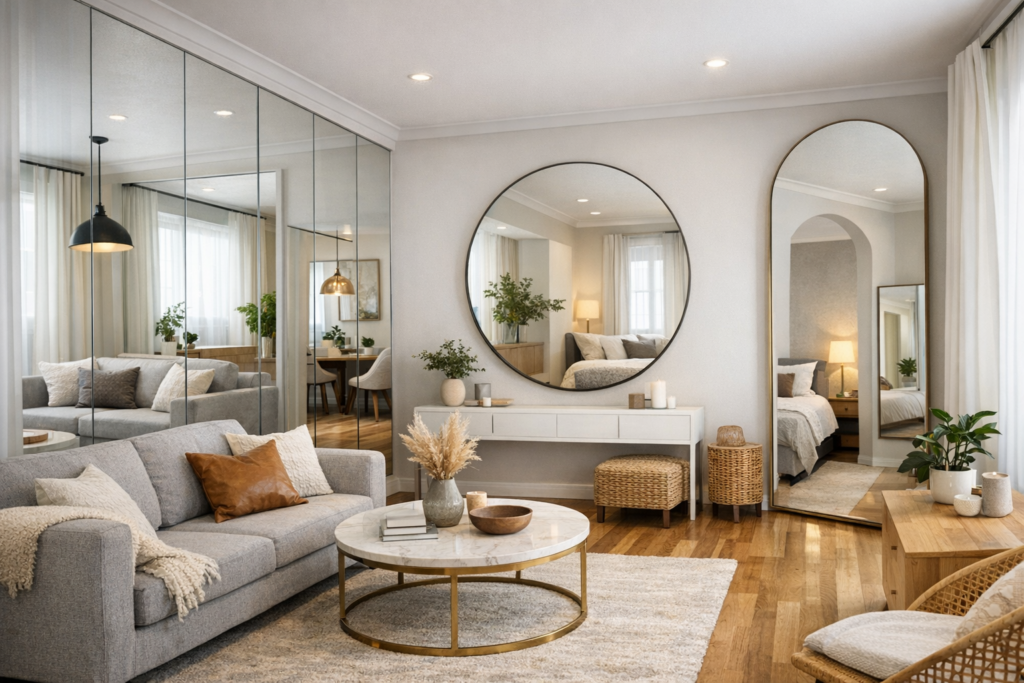
Wall Mirror Ideas to Make Small Rooms Look Bigger
janvier 19, 2026Small rooms can feel cozy and intentional, but they can also feel tight if the layout and lighting aren’t doing you any favors. One of the simplest ways to visually expand a space is with the right wall mirror—placed thoughtfully, sized correctly, and paired with the right frame and finish. Below are practical, style-forward wall mirror ideas that make compact rooms look bigger, plus clear comparisons so you can choose what works for your home (and your lease).
Why Mirrors Make Small Rooms Look Bigger (And When They Don’t)
Mirrors create the illusion of depth by reflecting light and repeating visual elements. In small spaces, that reflection can “double” the perceived volume of the room and brighten dim corners. But mirrors aren’t magic on their own—placement and what they reflect matter just as much as the mirror itself.
The two big effects: light + depth
Light is the fastest way to make a room feel larger. A mirror positioned to catch daylight from a window or glow from a lamp spreads that light farther across the room. Depth is the second key: a mirror reflects the room back at you, making the eye read more space than actually exists.
What can go wrong (and how to avoid it)
A mirror that reflects clutter, a blank wall, or a dark corner can make a room feel busier or even smaller. Before you hang anything, stand where you usually enter the room and consider what the mirror will show from that angle.
Quick fix checklist:
- Make sure the mirror reflects something attractive: a window, art, greenery, a styled shelf, or a light source.
- Avoid reflecting laundry piles, crowded countertops, or a tangle of cables.
- If the room is very narrow, choose a vertical mirror to emphasize height rather than width.
Best Wall Mirror Placements for Small Rooms
If you only change one thing, change placement. A moderately priced mirror in the right spot usually outperforms an expensive mirror in the wrong spot.
1) Opposite a window: the “second window” trick
Hanging a mirror directly across from a window is one of the most effective ways to boost brightness and openness. It reflects the outdoor view and daylight, creating the feeling of an additional light source.
Best for: living rooms, bedrooms, studio apartments, and any space that gets decent natural light.
Tip: If the window view isn’t great (parking lot, blank wall), angle the mirror slightly to catch the brightest part of the window without spotlighting the view.
2) Perpendicular to a window: soften glare, still amplify light
No spot directly opposite your window? Place the mirror on a side wall near the window instead. You’ll still bounce light around, but you’ll reduce harsh glare and avoid reflecting the window frame straight-on.
Best for: rooms with TV screens (less glare), home offices, and rental spaces where you can’t place large anchors on certain walls.
3) Behind a console or sofa: create layered depth
A mirror above a slim console table or behind a sofa adds depth and creates the impression of a wider room. This works especially well when you style the console with a lamp and a small tray—those items will also reflect, making the setup feel more substantial without taking up more floor space.
Best for: narrow living rooms, entryways, and “pass-through” spaces where you want visual interest without bulk.
4) Entryway mirrors: make the first impression feel expansive
Small entryways often feel boxed in. A medium-to-large mirror placed where it catches overhead lighting or daylight from a nearby room makes the entire home feel more open from the moment you walk in.
Practical bonus: It’s also the place you’ll actually use a mirror daily, which makes it a high-value decor purchase.
5) Over a dresser or vanity: brighten and “lift” the wall
Bedrooms and bathrooms can feel tight because furniture and fixtures create heavy visual blocks. A mirror above a dresser or vanity breaks up that density and reflects light upward, making ceilings feel higher.
Tip: If you’re short on wall space, choose a taller mirror rather than wider. Vertical lines help small rooms feel less compressed.
Mirror Styles That Visually Expand a Room (With Clear Comparisons)
Once placement is set, style is about controlling scale, lines, and reflection. Here are mirror types that reliably make a small room look bigger, plus how they compare.
Oversized statement mirrors: maximum impact, fewer pieces
If you want the biggest “wow” per square inch, go oversized. A large mirror creates a strong depth illusion and reduces the need for multiple small wall pieces (which can look busy in a tight room).
Best for: studios, small living rooms, bedrooms with minimal wall decor.
Trade-off: larger mirrors are heavier and require more secure hanging hardware.
Full-length wall mirrors (not just for outfits)
Full-length mirrors visually stretch a room, especially when they reflect a window or a bright lamp. They’re also perfect for renters because many can be leaned rather than mounted.
Leaning vs. hanging:
- Leaning looks relaxed, is renter-friendly, and lets you reposition easily.
- Hanging saves floor space and feels more polished, especially in narrow halls.
Round mirrors: soften tight angles and add breathing room
Small rooms can feel “boxy” because everything is rectangular—walls, furniture, windows, doors. A round mirror breaks that pattern and makes the space feel less rigid.
Best for: bathrooms, above small consoles, over nightstands (when paired with sconces).
Trade-off: round mirrors can feel smaller than a rectangular mirror with the same diameter because you lose corner coverage. Choose a slightly larger size than you think you need.
Arched mirrors: add height and a gentle architectural feel
Arched mirrors pull the eye upward, which is ideal for low ceilings or compact bedrooms. They also add a softer “built-in” vibe without remodeling.
Best for: bedrooms, entryways, and anywhere you want a subtle statement.
Style note: arched mirrors pair well with both modern and traditional decor, depending on the frame.
Panel, grid, or “windowpane” mirrors: expand width while adding structure
These mirrors mimic the look of a window and can make a room feel like it has an extra architectural opening. They’re great when your space lacks character, but you still want clean lines.
Best for: industrial, modern farmhouse, and transitional rooms.
Trade-off: the grid lines interrupt reflection slightly, so they amplify light well but create a less “seamless” expansion than a plain mirror.
Frameless mirrors: the cleanest, biggest-looking reflection
If your goal is purely to make a room feel larger, frameless or very thin-frame mirrors create the least visual interruption. They can make walls feel more continuous and airy.
Best for: minimalist spaces, small bathrooms, and modern interiors.
Trade-off: frameless mirrors can feel a bit stark if the rest of the room lacks texture. Add warmth with wood accents or soft textiles.
Size, Shape, and Frame: How to Choose the Right Mirror for Your Space
Choosing a mirror isn’t just about what looks good online—it’s about proportion, reflection quality, and how the frame interacts with the room’s existing finishes.
Use a simple sizing rule for furniture pairings
When placing a mirror above a piece of furniture (dresser, console, sofa), aim for a mirror that is about two-thirds to three-quarters the width of the furniture. This usually looks balanced and intentional without overpowering the wall.
Example: If your console is 48 inches wide, a mirror around 32 to 36 inches wide tends to look right.
Pick shape based on what your room needs
- Need height? Choose a tall rectangle or an arched mirror.
- Need softness? Choose a round or oval mirror to reduce “boxiness.”
- Need width? Choose a wide rectangle or a panel mirror to stretch the wall visually.
Frame comparisons: what each finish does visually
The frame isn’t just decoration—it changes how large the mirror reads and how much contrast it adds.
- Thin metal frames (black, brass, chrome): crisp and modern; great for small rooms because they define the mirror without eating into reflection area.
- Light wood frames: warm and airy; ideal for Scandinavian, coastal, or relaxed interiors; keeps a small room feeling open.
- Dark or chunky frames: dramatic and grounding; best when the room already feels bright and you want a focal point.
- Frameless: biggest-looking reflection; best for pure spaciousness and a clean finish.
Don’t forget reflection quality
Higher-quality glass gives a clearer reflection and a more “open” feeling. Distorted reflections can subtly make a room feel off. When shopping online, look for mirrors described as high-clarity or with quality backing, and check customer photos if available. LifeDeals regularly curates lifestyle-friendly home finds, so it’s worth browsing for mirrors that balance clarity, style, and value.
Room-by-Room Mirror Ideas (Real-World, Small-Space Friendly)
Small living room: create a brighter “center of gravity”
Try an oversized rectangular mirror above a slim console behind the sofa, or a large round mirror over a compact media stand. If your living room is narrow, a tall mirror on the longest wall can relieve that hallway-like feeling.
Pairing tip: Place a lamp within sight of the mirror. The reflected glow helps at night when natural light isn’t available.
Tight bedroom: add height without crowding the floor
Mount a vertical mirror near the closet or lean a full-length mirror in a corner where it will reflect a window. If your bedroom has limited wall space, an arched mirror can add height and elegance without requiring multiple decor pieces.
For renters: leaning mirrors are easy to move and can be anchored with anti-tip straps for safety.
Small bathroom: go wider and brighter
Bathrooms benefit from mirrors that span more of the vanity width. A wider mirror reflects more light and makes the room feel less narrow. If you want a modern look, consider a thin-frame metal mirror; if you want a softer feel, go with an oval.
Lighting note: If your bathroom light is harsh, placing sconces or a softer bulb near the mirror can make the whole space feel more upscale.
Entryway or hallway: elongate the path
A vertical mirror in a hallway draws the eye forward and reduces that “tunnel” effect. In a small entryway, a mirror above a narrow shelf gives you function (keys, mail drop) without bulk.
Pro trick: If the hallway feels dark, place the mirror where it can catch light from an adjacent room.
Installation and Safety Tips (Especially for Renters)
Mirrors are heavier than most wall decor, so it’s worth doing this part carefully.
Choose the right mounting method
- Wall anchors or studs: best for heavy mirrors and high-traffic areas.
- Picture hanging systems: useful when you want flexibility for repositioning.
- Leaning mirrors: renter-friendly and easy, but use anti-tip hardware if kids or pets are around.
Get the height right
For most wall mirrors, center the mirror roughly at eye level. Over furniture, leave a little breathing room so it doesn’t look cramped—often a few inches above the surface is enough. The goal is a clean, intentional line that helps the room feel organized (and therefore larger).
Keep the reflected view clean
Mirrors amplify what’s already there. A quick edit—hiding cords, corralling small items into a tray, or adding a plant—makes the mirror effect feel more like “spacious design” and less like “double the clutter.”
FAQ: Wall Mirror Ideas for Making Small Rooms Look Bigger
What size mirror makes the biggest difference in a small room?
Bigger mirrors generally create a stronger sense of openness because they reflect more light and more of the room. If you can’t go oversized, choose a mirror large enough to reflect a window or a key light source, rather than a small decorative mirror that reflects mostly wall.
Is it better to use one large mirror or several small mirrors?
In small rooms, one large mirror usually looks cleaner and makes the space feel larger. Several small mirrors can work, but they add visual “breaks,” which can make a tight room feel busier unless the arrangement is very cohesive.
Where should you avoid putting a mirror?
Avoid placing a mirror where it reflects clutter, a messy countertop, or an unflattering view (like a crowded corner). Also be cautious placing mirrors directly opposite very bright bulbs if glare bothers you—try a side wall placement instead.
What mirror frame color is best for a small room?
Thin frames in lighter woods or sleek metals tend to keep the look open and airy. Dark, thick frames can still work, but they create stronger contrast—best used when you want a deliberate focal point and the room already has good light.
Conclusion: Make Your Space Feel Bigger With One Smart Upgrade
Mirrors are one of the most practical tools for making small rooms look bigger because they improve light, add depth, and elevate your walls without taking up precious floor space. Focus on placement first (reflect light and attractive views), then choose a shape and frame that supports what your room needs—height, softness, width, or a clean, seamless look.
If you’re ready to refresh a room quickly, explore wall mirror options online and compare sizes and finishes with your space in mind. LifeDeals makes it easy to browse stylish home pieces that balance function and design, so you can find a mirror that opens up your room and fits your everyday lifestyle. For more space-smart decor finds, keep an eye on LifeDeals—small upgrades can make a surprisingly big difference.