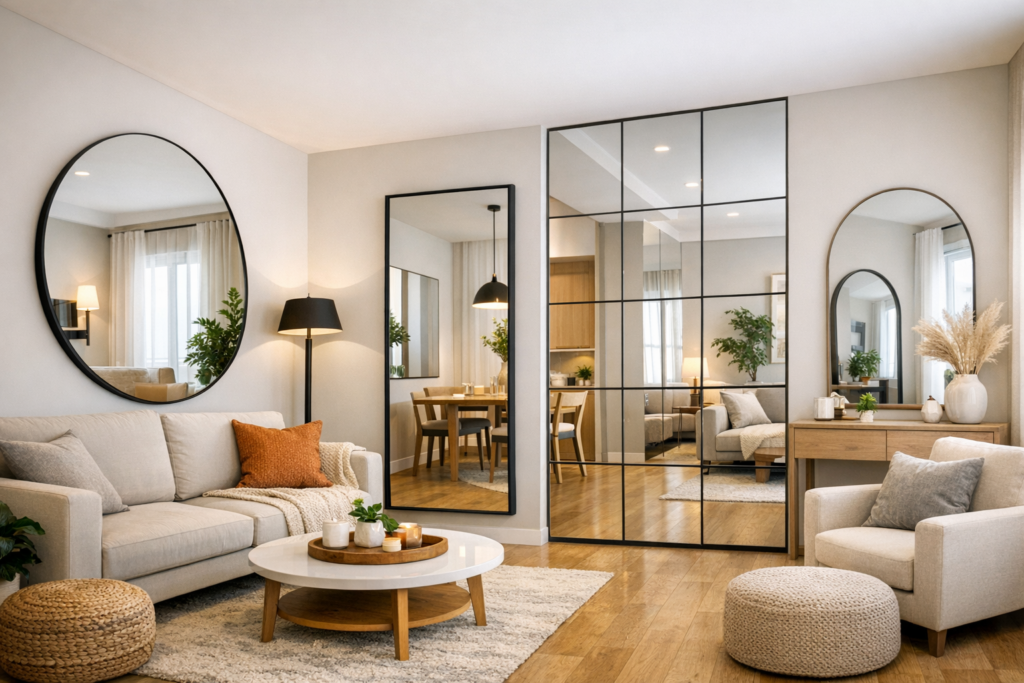
Wall Mirror Ideas to Make Small Rooms Look Bigger
janvier 19, 2026Small rooms can feel cozy, but they can also feel cramped when light and sightlines are limited. A well-placed wall mirror is one of the fastest, most stylish ways to open up a space without renovating. Mirrors bounce light, extend visual depth, and can even make ceilings feel higher. The trick is choosing the right mirror style and placing it strategically so it works with your room’s layout, lighting, and furniture.
Below are practical wall mirror ideas (with comparisons and placement tips) to help your rooms feel larger and brighter. If you’re browsing for options, LifeDeals carries a wide range of wall mirrors in different shapes, frames, and sizes—so you can find something that fits both your space and your budget.
Why Wall Mirrors Make Small Rooms Look Bigger
Mirrors “expand” a room in three main ways: light reflection, visual continuation, and focal-point control. When you know which effect you need most, it becomes much easier to pick the right mirror and location.
1) They amplify natural and artificial light
Mirrors reflect whatever light they receive. In small rooms with one window or a single ceiling fixture, a mirror can double the perceived brightness by redirecting light into darker corners. This alone can make a room feel more spacious, because bright rooms tend to read as larger.
2) They create visual depth
A mirror acts like a “second window” into the room, making the wall feel farther away than it is. The effect is strongest when the mirror reflects an open area (like a walkway, a window view, or a clean vignette) rather than clutter.
3) They pull attention away from tight dimensions
A thoughtfully chosen mirror becomes an intentional design element. Instead of noticing the room’s narrow width, you notice the statement piece and the light it brings. This is especially helpful in apartments where you can’t change layout or add windows.
Best Wall Mirror Placements (Room-by-Room)
Placement is more important than price. Even a beautiful mirror won’t help if it reflects a messy corner or blocks circulation. Use the suggestions below as a starting point, then adjust based on where your light enters and how you move through the room.
Entryway: Make the first impression feel open
Small entryways often lack natural light and can feel like a hallway bottleneck. A mirror here adds brightness and gives you a practical last-look spot before heading out.
Try this:
Hang a medium-to-large mirror above a slim console table or wall shelf.
If space is tight, choose a vertically oriented mirror to emphasize height.
Position it to reflect a nearby light fixture or the brightest adjacent room.
Comparison tip: A round mirror softens sharp angles and feels welcoming; a rectangular mirror looks more architectural and tends to “stretch” walls visually.
Living room: Reflect the best view in the room
In a small living room, the goal is to expand sightlines. Mirrors work best when they reflect a window, a piece of art, or a calm, styled area rather than the TV or a busy bookshelf.
Try this:
Place a large mirror on the wall perpendicular to a window to bounce light across the space.
If you can only use one mirror, make it big enough to read as a feature (think “anchor piece,” not “tiny accent”).
Hang it behind a sofa if the opposite wall has light or an attractive view to reflect.
Practical note: If your living room already has multiple reflective surfaces (glass tables, glossy cabinets), consider a matte or thin-framed mirror to avoid visual “sparkle overload.”
Bedroom: Brighten without over-stimulating
A bedroom should feel airy, but not harsh. Mirrors can help, especially in smaller rooms where dressers and wardrobes take up valuable wall space.
Try this:
Hang a mirror above a dresser to combine function and style.
Use a tall mirror on a narrow wall to make ceilings feel higher.
Avoid placing a mirror where it reflects clutter on the nightstand or laundry baskets—what it reflects is what your room “multiplies.”
Comparison tip: A warm-toned frame (wood, brass) adds softness; a black frame adds contrast and can look crisp in minimalist rooms.
Dining area: Add depth and “special occasion” glow
Dining nooks and compact dining rooms benefit from mirrors because candlelight and pendant lighting look more abundant when reflected. This makes the area feel more expansive and intentional.
Try this:
Place a wide mirror on the wall adjacent to the table to broaden the space visually.
Reflect a chandelier or pendant light for an elevated look.
Practical note: If your dining area opens into the kitchen, position the mirror so it reflects the dining space rather than the busiest kitchen surfaces.
Bathroom: Double the light, keep it clean-lined
Bathrooms are often the smallest rooms in the home, and they’re filled with hard surfaces that show every detail. A mirror can instantly boost brightness, but it’s also a daily-use item—durability and easy cleaning matter.
Try this:
Choose a mirror that’s slightly wider than the sink or vanity for balance.
If you have limited wall width, a tall mirror can make the room feel higher.
Consider a moisture-resistant frame finish if ventilation is limited.
Comparison tip: Frameless mirrors feel sleek and visually “lighter,” while framed mirrors add personality and can tie into hardware finishes.
Mirror Styles That Work Best in Small Rooms (With Comparisons)
Style affects how “heavy” a mirror feels on the wall. In small rooms, you typically want a design that adds presence without visual bulk.
Oversized rectangular mirrors: Best for maximum expansion
If you want the strongest illusion of more space, go oversized. A large rectangular mirror reads like an architectural feature and creates a wide “window” effect.
Best for: living rooms, dining rooms, long hallways, studio apartments.
Watch out for: placing it where it reflects clutter or an awkward angle (like a tight corner). If you can’t control what it reflects, size won’t help.
Round mirrors: Best for softening tight layouts
Round mirrors reduce the boxy feel that small rooms can have, especially when you have lots of rectangular furniture (sofas, beds, dressers).
Best for: entryways, bathrooms, above a console, above a dresser.
Comparison: Round mirrors feel more decorative; rectangles feel more spatially “stretching.” If your room feels harsh, go round. If it feels narrow, go rectangular.
Arched mirrors: Best for creating “height” and elegance
Arched mirrors naturally draw the eye upward, which can make a low ceiling feel taller. They also add a classic, boutique-hotel vibe without needing much additional decor.
Best for: bedrooms, entryways, living rooms with traditional or transitional styling.
Watch out for: narrow arches that look undersized on a large wall—when in doubt, go larger.
Grid or windowpane mirrors: Best for style, moderate for space
These mirrors create the look of extra windows, which can be fantastic in rooms with limited natural light. However, heavy grids can slightly reduce the “continuous depth” effect compared to a single-pane mirror.
Best for: farmhouse, industrial, modern classic interiors; rooms that need character.
Comparison: If your priority is maximum spaciousness, choose a cleaner design with a thin frame. If your priority is adding architectural interest, a grid mirror can be worth it.
Frameless and thin-frame mirrors: Best for a light, airy look
Minimal frames make the mirror feel like part of the wall rather than an object sitting on it. This is especially useful in very small rooms where a chunky frame can feel visually heavy.
Best for: bathrooms, minimalist bedrooms, modern apartments.
When you’re ready to shop, LifeDeals is a convenient place to compare these styles quickly—especially if you want to filter by size, frame color, or shape and see what fits your space.
How to Choose the Right Size (Without Guesswork)
Size is where most mirror decisions go wrong. Too small looks like an afterthought; too large in the wrong spot can feel overwhelming. Use these rules to land on a “just right” option.
Use the “two-thirds” guideline over furniture
If you’re hanging a mirror above a console, dresser, or vanity, aim for a mirror that’s about two-thirds the width of the furniture below it. This keeps proportions balanced and makes the setup look intentional.
Go taller in narrow spaces
In tight rooms, vertical mirrors often work better than wide ones because they emphasize height and keep walking paths visually clear. This is especially effective in entryways and small bedrooms.
Consider what the mirror will reflect
Before you commit, stand where the mirror will hang and imagine the reflection. If it will reflect a window, a lamp, or open floor space, great. If it will reflect a laundry pile or a crowded countertop, reposition it or pick a different wall.
Quick measuring tips
For a vanity mirror: match the width of the vanity or go slightly narrower for a clean look.
For a statement mirror in a living room: larger is typically better, as long as it doesn’t block switches, vents, or doors.
For a hallway: consider a series of medium mirrors if one large mirror feels too dominant.
Design Tricks: Make Mirrors Work Even Harder
Once you’ve chosen a mirror, small styling decisions can dramatically boost the “bigger room” effect.
Pair mirrors with the right lighting
Mirrors and lighting are a team. If your room feels dim, add a floor lamp or wall sconce near the mirror so it has something bright to reflect. Warm white bulbs tend to feel cozy; neutral white can feel crisper and more modern.
Use mirrors to create symmetry (without clutter)
Symmetry makes spaces feel calmer and more open. Try matching sconces on either side of a mirror, or centering a mirror above a console with two identical objects (like small lamps) on either side. Keep the surface styling minimal to avoid visual noise.
Layer with art for a curated look
If you love gallery walls but your room feels small, let one mirror act as the “light source” within the gallery. Mix it with art prints in similar tones so it feels cohesive rather than busy.
Choose frame finishes that match your room’s “weight”
Frames change the visual density of a wall.
Light frames (thin metal, light wood): best for making rooms feel airy.
Dark frames (black, deep walnut): great for contrast and a defined focal point.
Ornate frames (carved, gilded): best when the mirror is the hero and the rest of the wall is simple.
If you’re unsure, browsing LifeDeals can help you compare the same size mirror in different frame finishes—often the easiest way to see what suits your decor style.
Common Mistakes to Avoid in Small Rooms
Mirrors are forgiving, but a few missteps can cancel out the spacious effect.
Hanging a mirror too high
A mirror should relate to the furniture and to eye level. If it’s floating near the ceiling, it can feel disconnected and won’t reflect the right parts of the room. As a general guide, center the mirror around eye level or a bit above if it’s over furniture.
Reflecting clutter (and doubling it)
Mirrors don’t hide mess; they repeat it. If your mirror faces a crowded shelf or a pile of shoes, the room will feel busier. Clear the reflected zone or rotate the mirror to face something calmer.
Going too small “just to be safe”
In many small rooms, undersized decor makes the space feel even smaller because it emphasizes how much empty wall remains. A larger mirror often looks more confident and does more to expand the room.
Overusing mirrors in one sightline
Multiple mirrors can be beautiful, but too many reflections can feel chaotic. If you already have mirrored closet doors or glossy finishes, consider one strong statement mirror rather than several competing ones.
FAQ
Where should I place a wall mirror to make a room look bigger?
Place it where it will reflect a window, a light fixture, or open floor space. A mirror perpendicular to a window often spreads natural light across the room, while a mirror opposite a clean focal point creates strong depth.
Is a round or rectangular mirror better for a small room?
Rectangular mirrors usually create a stronger “expanded wall” effect, especially in narrow rooms. Round mirrors are better when you want to soften a boxy layout or add a gentle focal point above a console or vanity.
How big should a mirror be over a dresser or console?
A reliable rule is about two-thirds the width of the furniture below it. This keeps the arrangement proportional and helps the mirror look intentional rather than like a small accessory.
Do framed mirrors make a room look smaller?
Not necessarily. Thin frames often look airy and work well in very small rooms. Thicker or ornate frames can still work if the mirror is large enough and the surrounding wall is kept simple—so the frame reads as a statement, not clutter.
Conclusion
Making a small room look bigger doesn’t require major changes—just smart reflection. Choose a mirror that fits the scale of your wall, place it where it captures light and clean sightlines, and use frames and styling that match the “visual weight” of your room. With the right mirror, even a compact space can feel brighter, taller, and more open.
If you’re ready to upgrade, explore LifeDeals online to compare wall mirror sizes, shapes, and frame finishes in one place and find a piece that makes your space feel instantly more spacious.