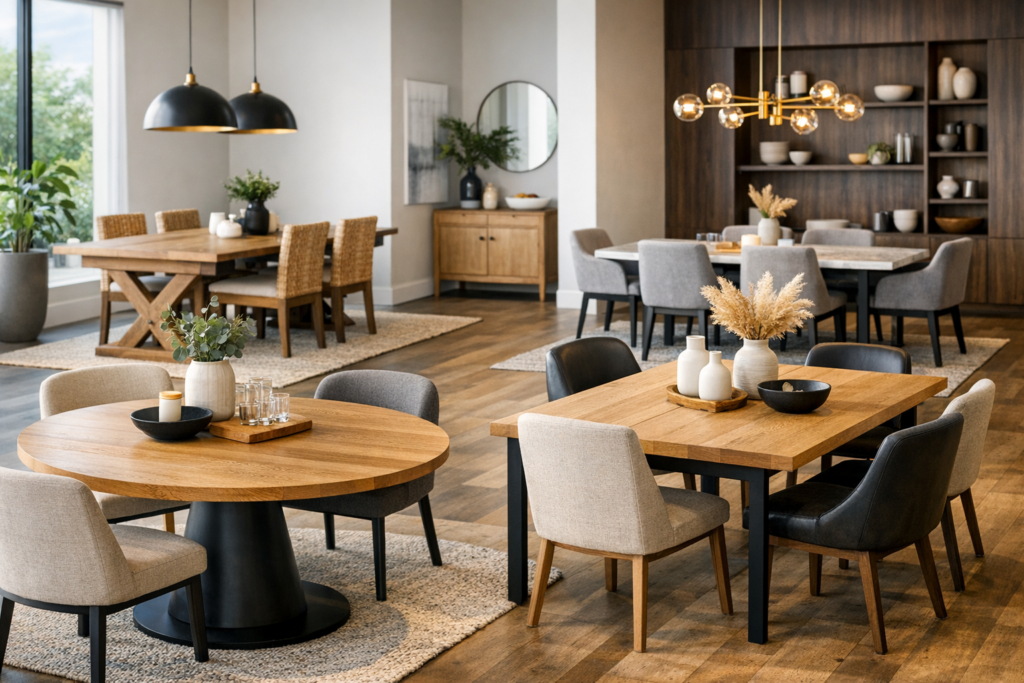
How to Choose the Right Dining Table for Your Home
janvier 31, 2026A dining table is where daily routines meet special moments: quick breakfasts, homework sessions, weekend dinners with friends, and holiday gatherings. Choosing the right one isn’t just about picking a style you like—it’s about sizing it correctly, matching it to how you live, and selecting materials that will look great and hold up over time. This guide walks you through the practical decisions that matter most, so you can confidently find a dining table that fits your home and your lifestyle.
1) Start With Space: Size, Shape, and Flow
The best-looking table can still feel “wrong” if it crowds the room or blocks pathways. Before you shop, take a few measurements and think about how people move through the space.
Measure the room (and the real usable area)
Measure the dining area’s length and width, then consider doors, cabinets, radiators, and any furniture that shares the zone (sideboards, kitchen islands, bar carts). You’re not just fitting a table—you’re planning for chairs, elbows, and circulation.
Comfort rule of thumb: Aim for about 90–100 cm (35–40 in) of clearance from the table edge to the wall or the nearest obstacle so people can pull chairs out and walk around comfortably. If your space is tight, 75–85 cm (30–34 in) can work, but it will feel more compact.
Choose a shape that supports the room’s layout
Different shapes solve different problems. Here’s a practical comparison:
Rectangular tables: The most versatile and common. They fit long rooms, seat more people, and pair well with benches. Great for households that host often or need a table that can double as a workspace.
Round tables: Ideal for smaller rooms and for conversation—everyone faces everyone. Round tables reduce sharp corners, which can help in narrow walkways or homes with kids. The trade-off: you typically seat fewer people than a rectangle of similar footprint.
Square tables: Best for small, square rooms or seating four. They can feel intimate, but scaling up can be tricky—very large square tables can feel too wide for comfortable passing of dishes.
Oval tables: A smart compromise: they keep the length of a rectangle but soften the corners and can improve flow in tighter spaces.
Plan seating capacity the realistic way
Seat counts in product listings can be optimistic. A more realistic approach is to consider “personal space” at the table.
General guidelines:
Plan for about 60 cm (24 in) of table edge per person for everyday comfort. For a more relaxed, spacious setting (or larger chairs), aim for 65–75 cm (26–30 in) per person.
Typical seating expectations:
Rectangular: 120–150 cm (47–59 in) often seats 4; 160–180 cm (63–71 in) often seats 6; 200–240 cm (79–94 in) often seats 8 (depending on chair width and table leg placement).
Round: 90–110 cm (35–43 in) often seats 4; 120–135 cm (47–53 in) often seats 6.
Pro tip: Pay attention to the base. Pedestal bases can be more flexible for squeezing in an extra chair, while corner legs can limit where seats comfortably fit.
Don’t forget chair clearance and ergonomics
A standard dining table height is about 75 cm (29–30 in). Most dining chairs are designed for that. Leave roughly 25–30 cm (10–12 in) between the seat height and the underside of the tabletop for comfortable legroom. If you’re mixing and matching chairs, check dimensions so you don’t end up with armrests that hit the table apron or seats that feel too low.
2) Match the Table to Your Lifestyle: Daily Use, Guests, and Multi-Function Needs
A table that looks perfect in a showroom should still work for your actual week—busy mornings, pets, kids, and the occasional dinner party. Think about how you use your dining area most days.
Everyday household vs. frequent hosting
If it’s mostly daily meals: Prioritize durability, easy cleaning, and comfortable spacing. A slightly smaller table with great flow can feel better than a large table you rarely fill.
If you host often: Consider an extendable table or a design that allows flexible seating (like a pedestal base or the option to add a bench). An extension table can keep your room open day-to-day while still accommodating guests.
Extension styles to know:
Leaf extensions: Can be stored separately or built-in. Great for versatility; just ensure you have a storage plan for separate leaves.
Drop-leaf: Hinged sides fold down. Perfect for small spaces, though seating at the ends can be limited when folded.
Open-plan living: define zones without clutter
In open-plan spaces, your table helps visually anchor the dining zone. A larger rug under the table, consistent wood tones, or a statement pendant light can help define the area. If your dining area is near the living room, consider a table silhouette that doesn’t feel heavy—rounded edges, slimmer legs, or lighter finishes can keep the space airy.
Work-from-home and homework-friendly choices
If your dining table doubles as a desk, you’ll want:
Enough tabletop depth for a laptop plus a notebook (or two place settings) without feeling cramped.
A surface that’s comfortable to write on (some highly textured wood grains can be bumpy).
A finish that won’t show every fingerprint or minor scratch.
A rectangular table is often the easiest for multi-use, but a larger round table can work beautifully if you prefer a more social, shared-work feel.
Small-space solutions that still feel “grown-up”
If you’re furnishing an apartment or a compact dining nook, you can still get a high-quality look without sacrificing function:
Ideas that work well:
Choose an oval or round table to improve walkability around tight corners.
Pair a smaller table with a bench on one side to tuck seating fully under the table.
Look for tables with pedestal bases to maximize legroom and flexible seating.
When browsing LifeDeals online, filter by size first, then compare shapes and bases. It’s the quickest way to avoid falling in love with a table that won’t fit your room.
3) Materials and Construction: What Lasts and What to Watch For
Material choice is where style meets reality. Spills happen. Hot dishes show up. Chairs scrape. The right material depends on how you live and how much maintenance you’re willing to do.
Solid wood: timeless and repairable
Pros: Durable, classic, can be refinished or repaired. Many people love how wood develops character over time.
Cons: Can be more expensive; may react to humidity and temperature changes; some finishes require a bit of care.
Good to know: Hardwoods (like oak, walnut, acacia, or rubberwood) generally resist dents better than softer woods. If you like a rustic look, a wood with visible grain and a forgiving finish can hide daily wear.
Veneer and engineered wood: budget-friendly with style
Pros: Often more affordable; can offer consistent color and a sleek look; typically more stable than solid wood in changing climates.
Cons: Veneers can be harder to repair if deeply scratched; quality varies widely.
If you’re choosing veneer, look for sturdy construction, quality edge-banding, and a finish that feels smooth and well-sealed. A well-made veneered table can be a smart choice for renters who want a polished look without the price tag of solid hardwood.
Glass: light, modern, and visually spacious
Pros: Makes small rooms feel larger; pairs with many decor styles; easy to wipe clean.
Cons: Shows fingerprints and smudges; can feel cold or noisy; chips are possible; may not suit households with very young kids.
If you love the look of glass, consider the base carefully—this is where stability and style come together. A sturdy metal or sculptural base can elevate the whole room.
Stone and faux-stone tops: statement-making and durable (with caveats)
Pros: High-end appearance; excellent heat resistance in many cases; very durable against scratches (depending on the stone).
Cons: Heavy; can be pricier; some natural stones stain without sealing.
For busy homes, faux-stone or sintered stone styles can offer a similar look with easier maintenance. Always check care instructions: some surfaces handle heat and stains beautifully, while others need coasters and quick wipe-downs.
Metal bases and mixed materials: sturdy and trend-resistant
Tables with metal legs and wood tops are popular for a reason: they’re stable, often easier to level, and suit modern, industrial, or contemporary interiors. Check for adjustable feet—especially helpful in older homes with uneven floors.
Construction details that matter
You don’t need to be a furniture expert, but a few details can help you buy with confidence:
What to look for:
Joinery and stability: A table should feel solid with minimal wobble. Reinforced corners and well-fitted joints make a difference over time.
Finish quality: Even staining, smooth edges, and sealed surfaces indicate better craftsmanship.
Leg placement: Legs set too far in can bump knees; legs at the corners can limit where chairs fit. Pedestal bases can be the most flexible.
When you browse dining tables on LifeDeals, compare photos of the underside and base design if available. Those images often reveal how comfortable the table will be in real use.
4) Style and Coordination: Make It Look Intentional
Your dining table is a major visual anchor, but it doesn’t have to match everything perfectly. The goal is cohesion, not a showroom set.
Pick a style direction (then keep it consistent)
Start by choosing one primary style cue:
Modern: clean lines, minimal detailing, often mixed materials.
Scandinavian: light wood tones, simple shapes, practical design.
Farmhouse: thicker tops, warm finishes, sturdy silhouettes.
Industrial: metal bases, reclaimed-looking woods, bold contrast.
Classic/traditional: richer woods, turned legs, more detailing.
Once you pick a direction, keep at least two elements consistent—like wood tone and chair silhouette, or table shape and lighting style.
Coordinate chairs the smart way
You can match chairs to the table, but mixing can look more curated. A few easy pairings:
Wood table + upholstered chairs for comfort and softness.
Dark table + lighter chairs for contrast (or vice versa).
Round table + armless chairs to preserve flow.
Make sure the chair seat height works with the table, and confirm armchair dimensions if you plan to tuck them under.
Rugs and lighting: the “finishing” pieces that change everything
A rug under the dining table should be large enough that chairs stay on it even when pulled out. If it’s too small, it can snag chair legs and feel awkward. For lighting, aim for a fixture that centers over the table and suits its scale—small pendant over a large table tends to look underwhelming.
If you’re building your dining setup from scratch, it’s often easiest to select the table first, then choose seating, then finalize rug and lighting. LifeDeals makes it simple to compare complementary pieces online so you can keep the whole look consistent.
FAQ: Choosing the Right Dining Table
1) What size dining table do I need for a small apartment?
Start with the clearance: try to keep about 90 cm (35 in) from the table edge to the wall or nearest obstacle when possible. In many apartments, a round 90–110 cm (35–43 in) table seats four comfortably and improves flow. If you need flexibility, consider a drop-leaf or a small extendable table.
2) Is a round or rectangular table better for conversation?
Round tables are typically best for conversation because everyone is facing inward and no one is stuck on a “corner.” Rectangular tables can still be great for hosting, especially if you use a narrower width and choose seating that keeps people comfortably close.
3) Which dining table material is easiest to maintain?
For low-maintenance living, look for sealed wood finishes, quality engineered tops, or surfaces designed to resist stains and heat (some faux-stone/sintered stone styles perform very well). Glass is easy to wipe but shows fingerprints quickly. If your household is busy, prioritize surfaces that don’t require constant careful handling.
4) Should I buy an extendable dining table?
If you host a few times a year but don’t want a large table taking up space every day, an extendable table is a practical choice. Check how the leaf stores, how easy it is to operate, and whether the extended table still allows comfortable legroom and chair placement.
Conclusion: A Dining Table That Fits Your Life
The right dining table balances three things: it fits your space, supports your routines, and holds up to real-world use. Measure carefully, pick a shape that suits your layout, prioritize materials that match your maintenance comfort level, and pay attention to construction details like the base and leg placement. When you’re ready to shop, exploring dining table options online through LifeDeals is a convenient way to compare sizes, finishes, and styles side by side—so you can choose a table you’ll enjoy every day, not just on special occasions.